
Explainer: Chieftaincy in Ghana
April 29, 2026
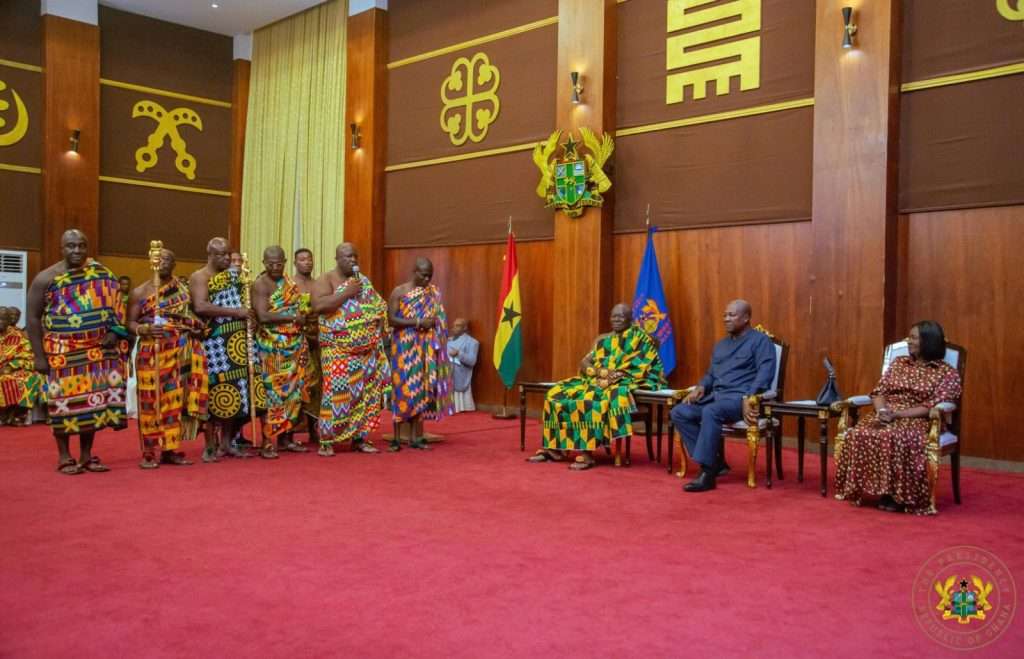
The President and Vice President welcome the Asantehene, the absolute monarch and traditional ruler of the Asante Kingdom
By Emerald Akorli, Research Associate at WACCE
Long before colonial borders and western partitions, the indigenous tribes of present-day Ghana governed themselves through systems of traditional leadership built on lineage, custom, and spiritual authority.
The system, called chieftaincy, is one of Ghana’s oldest and most enduring governance institutions. Today, chieftaincy operates alongside Ghana’s modern democratic government by a provision in the 1992 constitution, making it one of the few countries in the world where indigenous and contemporary governance formally coexist. However, today, at the root of 350 active conflicts throughout the country, chieftaincy is also a significant source of violent clashes in Ghana.
This explainer outlines the historical origins, benefits, and security challenges associated with Chieftaincy in Ghana.
What is Chieftaincy?
Ghana’s chieftaincy system predates colonialism by many centuries. Across the country’s diverse ethnic groups (the Akan, Ewe, Ga-Adangbe, Mole-Dagbani, and Guan), communities were organized into empires, kingdoms, and chiefdoms, each with their own rules for leadership, succession, and governance. Each ethnic group had structured systems with clearly defined hierarchies, customary laws, and mechanisms for accountability.
Although colonial rule disrupted these systems, it did not destroy them. In fact, British indirect rule often relied on traditional chiefs to administer local populations. After independence in 1957, Ghana’s new democratic governments, in a bid to reclaim autonomy of the indigenous people and separate the state from colonial rulership, decided to formally recognize chieftaincy by enshrining it in the 1992 Constitution. Chiefs today are constitutionally acknowledged, and a National House of Chiefs exists as an official institution of the Ghanaian state.
Conflict and Chieftaincy
Despite longstanding cultural legitimacy, the system has increasingly become entangled in recurring disputes over land ownership and royal succession. Across the country, these conflicts manifest differently depending on geography and the relationship between customary and formal governance systems.
In southern Ghana, where urbanization is more advanced and traditional authority often overlaps with formal state institutions, chieftaincy disputes are mostly channeled into the courts. While these legal processes can be lengthy and complex, they often prevent escalation into large-scale violence by providing institutional pathways for resolution.
In contrast, many communities in northern Ghana remain strongly rooted in communal living and traditional governance structures, with limited state presence in some areas. This has reinforced social cohesion and strong loyalty to traditional authority. However, it has also contributed to more intense and violent succession and inter-ethnic land disputes. In certain cases, these conflicts have resulted in mass fatalities, displacement of communities, and prolonged instability, such as the long-standing Bawku conflict and recurring farmer-herder conflicts.
This dynamic is important for understanding the broader security implications of chieftaincy in Ghana. Areas affected by recurrent traditional disputes are more vulnerable to wider insecurity, especially where weakened governance structures and unresolved local grievances create openings that can be exploited by criminal networks or radicalized individuals. In the long term, this makes chieftaincy-related conflicts not only a cultural or local governance issue but also a national security concern.
Why it Matters
In Ghana, chieftaincy is not merely historical; it remains deeply embedded in everyday governance. Traditional leaders continue to play active roles in community life, often serving as the most immediate and trusted authority within their jurisdictions.
Chiefs serve as arbitrators in local disputes, drawing on their knowledge of customary law to resolve conflicts in ways that are culturally legible and widely trusted. This reduces pressure on the formal court system and makes justice more accessible to ordinary people. They also mobilize community resources, calling on residents to contribute labor, money, and materials towards local infrastructure, agriculture, education, and health initiatives.
Additionally, traditional leaders are also important channels to disseminate public information. Festivals, funerals, and naming ceremonies become platforms for communicating government policies and raising awareness of community issues. In a country where trust in formal institutions is sometimes fragile, the chief’s voice carries a particular kind of legitimacy that the state cannot replicate.
Key Takeaways
Ghana’s chieftaincy system is one of the most resilient indigenous governance institutions on the African continent. It survived colonialism, adapted to independence, and found formal recognition within modern constitutional democracy.
At the same time, it is also a major cause of tension in the country. The presence of hundreds of ongoing disputes highlights how deeply questions of identity, land ownership, and succession remain contested in Ghanaian society, especially under the chieftaincy system. These conflicts are not anomalies, they reveal features of a system where customary legitimacy and statutory law operate side by side, but not in equal harmony throughout the country.
Across ethnic groups, the specifics differ in how chiefs are chosen, what symbols they carry, and what role women play; however, the underlying system is consistent. Leadership is rooted in lineage, legitimacy is grounded in custom, and authority is as much spiritual as it is political. At WACCE, working with chiefs and local communities is fundamental to our efforts to prevent conflict. For anyone seeking to truly understand governance and security in Ghana, we believe that chieftaincy remains one of the most important components.